
This museum bears the by-line, ‘An Entirely Virtual Collection’, because that sums up the entirety of its purpose and its existence. However, this choice did not come about entirely within a vacuum.
When I started this museum, I had three goals:
1. To organise my personal collection of antiques, seashells, sea-sponges, bric-a-brac and telephone equipment in a way which ensured all the details I knew about the items (provenance, the price I paid or where I collected it, etc.) was not lost.
2. To have a platform to show off my collection so other people could also enjoy looking at them and possibly learn about some of the unusual things I had found.
3. To challenge the idea that a museum or noteworthy personal collection had to include only the ‘best’, most expensive, or rarest items. I wanted to show that ordinary knick-knacks, common seashells, or cheap items can be appreciated for their beauty, their origins, their unusualness, and more.
Despite its carefully constructed façade, Mr Bowden’s Museum only has one employee – myself. All the work of researching the collection, managing it, photography and cataloguing of artefacts and so on, is done by me alone. There is no possibility of the museum gaining a physical gallery space for several reasons, the first being cost.
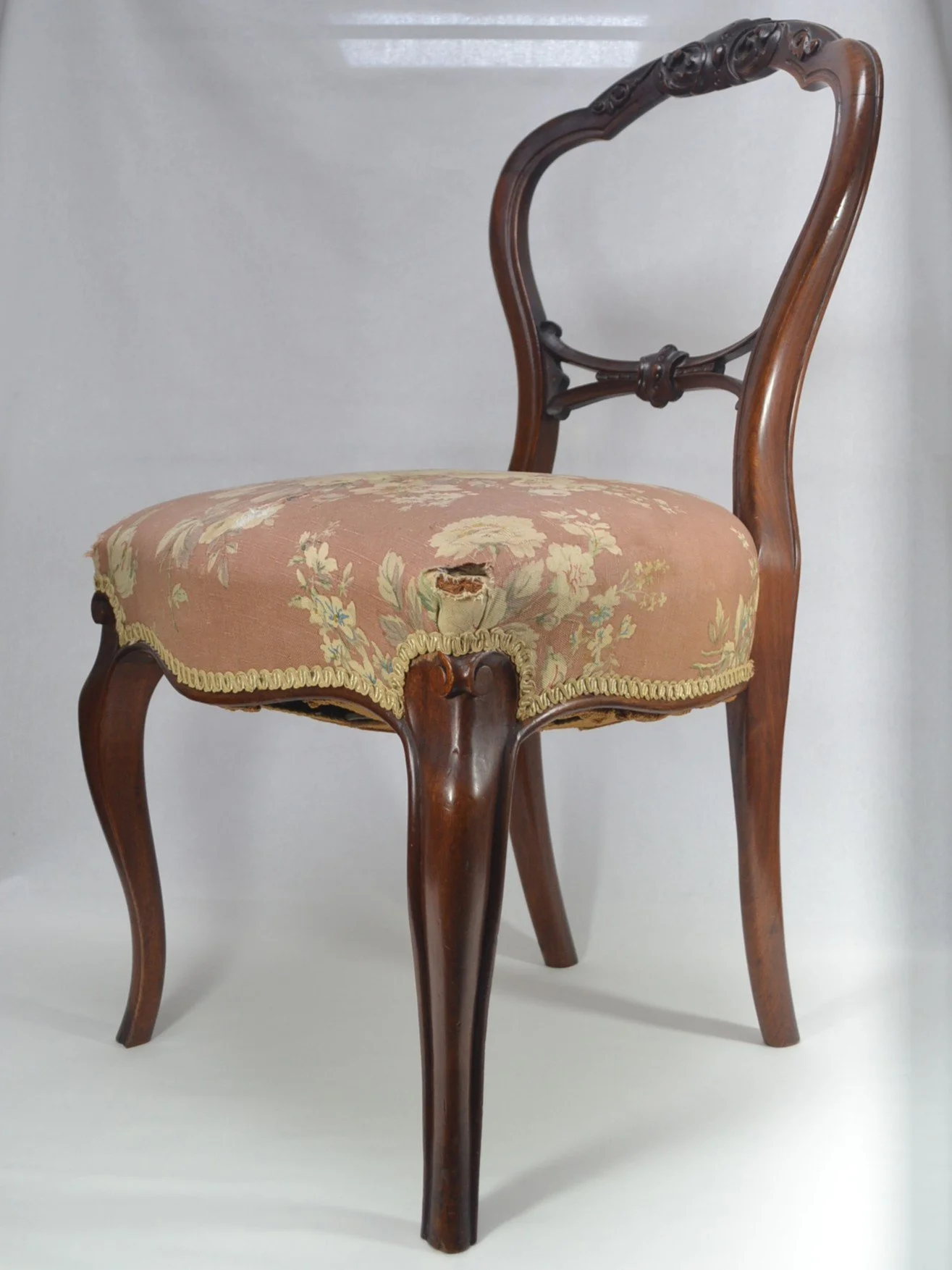
Victorian salon chair, 1860s (artefact A.2b), during the museum object photography process, showing backdrop before image editing.
The second is that while the concept works extremely well as a free, online museum, it would be difficult to attract visitors to a museum whose sole uniting theme is that the curator liked the look of something. More to point, to offset the cost of a gallery space, it would need to charge an entry fee, and that essentially kills the idea dead in the water.
So, the virtual space required for my museum is rented at a significantly cheaper cost than any physical locality and allows me (within reason) boundless room for expansion. It also allows the freedom to chop and change, to put up some things and take down others. Where a gallery would have to spend money and time repainting walls or changing the lighting around, I can quite easily add a new page to the website or select several profiles on the searchable catalogue to show off.
For the searchable catalogue, in particular, I owe a great deal of thanks to Philip Moorhouse for his homegrown Australian cataloguing program – The Collecting Bug. TCB, as I will call it, is the ideal place for small collections, as any visitors to the main site will see when browsing the other collections hosted publicly on it. Philip does a deal where any collection smaller than 200 entries can be hosted for free, and then a yearly hosting fee applies for collections that grow beyond that. Based on my analysis of the museum’s collections, we will well grow beyond 200 items in the future, but for now Mr Bowden’s Museum enjoys the free hosting.
The reason I went with TCB is that it is easy to use, affordable, and does exactly what the museum requires – a searchable, filterable online catalogue. I am no tech genius and all the YouTube video tutorials in the world could not help me to build what Philip has built to the same degree, so it is much easier to use TCB and link it from my website for the Bowdenian collection. It is important to know that the museum is not sponsored by TCB in anyway – this is just the testimonial of a Happy Customer.
I think there is a great deal of potential for the Virtual Museum as a concept. There are many organisations, particularly in Australia, but also around the world for whom the cost and difficulty of operating a physical space presents a barrier to showing off a collection or detailing an interesting history. And while there are a good many museums whose concept relies on the sense of place – such as a historic house, site of an important event in the past, or unique operation or structure (such as a mine, or factory, or railway station) – a disparate collection like mine does not require physical space to exist. It can exist without it. Unless I felt like opening up my house as a museum, a la David Roche, there is no reason for the Bowdenian Museum to exist in the physical world, as a place to go to.
As I say on the landing page of the website, we are open 24-7 – the Genteel Visitor can browse the collection from anywhere in the world which has an internet connection, at any time of the day or night, for free.
The physicality of a museum experience is important. I acknowledge this from my professional experience in the sector; I also do not think that Virtual Museums can replace physical museums, especially public and major research institutions. But I do advocate that the Virtual Museum, concerned with whatever infinitesimally niche subject matter one’s heart desires, has a definite place in the world of museums and museology, and deserves further study.