
When out antiquing, it is rare for the collector to find much in the way of provenance recorded on the label of an object for sale. Sometimes, there is a tantalising glimpse, such as ‘Brought back from PNG in 1950s’. Ebay.com or Gumtree.com sellers occasionally add relevant but largely anonymised details of an artefact’s provenance, vague about who and how but clear about what and when.
Trying to acquire some of this provenance information is sometimes perceived by antique and second-hand shop owners as unwelcome intrusions into their business practices, or a subtle comment that you believe they have been sourcing unethically. Frequently, explanations do little to help and sometimes incite more ire. Many shops operate on the principle that a buyer wants an object, pure and simple, divorced of the ‘wearisome’ and ‘troublesome’ issues related to provenance, origin, and the nature of an object’s acquisition.
Ethnographic material, which derives a significant portion of its value precisely from its source information, sits uncomfortably in the antique-buying sphere – because to ask the questions about who collected an item, from where, when, and how – raises the spectre of looting, unequal exchange, or exploitation. For the casual collector, these issues are likely to cause some anxiety; however, if one collector’s conscience does not permit them to purchase a suspect object, they must be aware that some other collectors will be untroubled by these concerns and purchase. This raises the question – if not me, then who? This is not an argument for purchasing, but there is an element of consideration that perhaps a more appropriate custodian might the collector who is aware of the problems and acknowledges them, rather than the collector who ignores these problems.
Most people out for the weekend looking for antiques and collectables often do not concern themselves with such worries – they see a nice thing and they buy it. Whether their appreciation is aesthetic, functional or merely about possessing one more of a class of objects is immaterial; they see the object and they buy it. The discerning collector, or the collector with more money, or the collector with an eye for quality, detail and provenance, will probably eschew the junk shop and the second-hand market in favour of the auction house, where (largely) credible research will be undertaken to better understand the history of the object (to inform its price). So, where does this leave the middle of the road collector?
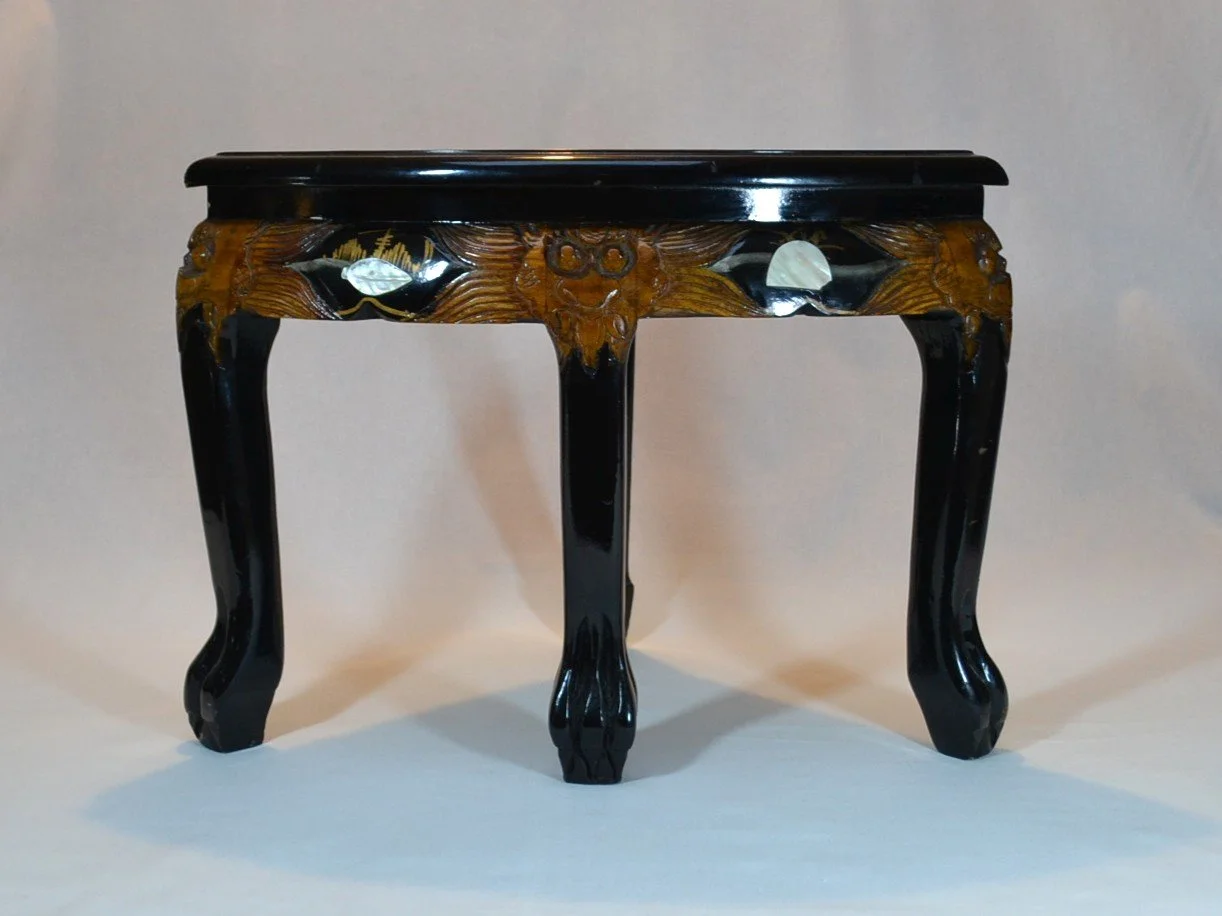
‘Oriental’-style quadrant table, featuring lacquer and nacre decoration. A20.
The collector of modest means, or who is aiming to collect some interesting items, while still caring about provenance and history, will encounter several speedbumps on the road to a well-researched, well-curated collection. If the collector wishes to better understand the history of the objects they buy from a small-town antique shop or collectables fair, they might do well to establish a rapport with the owner or seller, and through this work on gaining the trust required to acquire the information needed. I imagine few antique shop owners will liberally tell the casual buyer from whom they purchased an item, how much they paid, and much about the buyer’s history with the object (if they even know it at all).
To this end, Mr Bowden’s Museum purchases objects carefully, with strict attention paid to the following criteria:
1. Is the object likely to have been stolen, acquired from its maker through dishonest or unequal exchange, or have ethical issues attached to its purchase?
2. Does purchasing the object encourage or support the looting of foreign and local antiquities?
3. In the case of natural history items, does purchasing the item violate the Convention on International Trade in Endangered Species of Wild Fauna and Flora (CITES)? Is it illegal to harvest or collect in Australia or overseas, or does purchasing it encourage illegal or exploitative harvesting?
If these questions cannot be satisfied with an appropriate answer, then we do not purchase the object.
For these reasons, some categories in which we do not collect include:
Australian Aboriginal art and artefacts, as we believe in purchasing from artists or authorised dealers directly, where the chain of ownership and provenance can be established. Additionally, under the South Australian Aboriginal Heritage Act 1988 it is illegal to purchase or collect Aboriginal stone tools or implements.
Meteorites, as any which fall in South Australia are legally the property of the South Australian Museum.
Ivories. While there could be an exception made if they were already in Australia and likely to be over 100 years old, at this stage Mr Bowden’s Museum avoid purchasing any ivory items.
Items from overseas (either via ebay.com or from dealers in source countries) where potential ethical issues might arise, in addition to concerns about customs duties, pest management, etc. We restrict ourselves to objects already within Australia, but still apply the three relevant criteria questions above.
Historic taxidermy, due to the difficulty of storage and pest treatment. Additionally, historic taxidermy artefacts were often treated with arsenic or mercuric chloride and present a toxic health risk.
Comparatively, categories we collect in or aspire to collect in, where provenance is not as much of an issue or ethical concerns are limited, include:
Ceramics manufactured in Europe and Australia.
Glassware such as bottles, pressed glass, tablewares, and art glass manufactured in Europe, America and Australia.
Brasses, pewters, and EPNS silverwares, again made in Europe or Australia.
Historical technology, such as film cameras, telescopes, microscopes, and ‘history of science’ items.
Telephones, telephone exchanges, telegraph equipment, etc. manufactured for use in Australia with the colonial postal departments or the Commonwealth (1901-1975) Postmaster-General’s Department.
Australian postal history, including stamps, covers, information pamphlets, uniforms, etc.
Chinese or Chinoiserie antiques, such as cinnabar vases or bottles, salt or cork carvings, display stands, and furniture.
Japanese or Japonisme antiques and furniture.
Victorian era manufactured goods, furniture, and decorative arts in general.
In a majority of cases, these items do not require a full chain of ownership to establish their history, as maker’s marks, production information, or their design can be researched by other means. Where some additional information is available – for example, a telephone in use in a particular location or for a specific reason – this is excellent to have, but the absence of it does not throw the legitimacy of the phone into question.